The right personal trainer frequency depends on your goal, starting point, budget, and how confidently you can train on your own between appointments. Most people do best with one to three coached training sessions per week, paired with a personal workout plan they can follow independently. The real driver of results is not only how often you meet your trainer, but how consistently your weekly exercise frequency supports strength, conditioning, recovery, and nutrition habits.

How often should you see a personal trainer?
For most beginners, seeing a personal trainer two times per week is a strong starting point because it gives you enough coaching exposure to learn form, build momentum, and adjust quickly. If you are experienced, once per week may be enough for programming, accountability, and technique checks. If you have a major transformation goal, feel unsure in the gym, or need more structure, three sessions per week can help you build consistency faster.
A trainer helps you decide what belongs in each session and what should happen between sessions. That matters because general health guidelines for adults include both aerobic activity and muscle-strengthening work each week; the CDC summarizes adult targets as at least 150 minutes of moderate-intensity activity weekly plus two days of strength training. A good personal training schedule turns that broad recommendation into practical workouts that fit your body, schedule, and goal.
The best frequency depends on your goal
Your goal should shape your training rhythm. Someone learning basic strength exercises needs a different setup than someone preparing for a race, rebuilding after a long break, or trying to lose fat while protecting muscle. Instead of asking for one perfect number, think of personal trainer frequency as a sliding scale.
If you are brand new to exercise
Plan on two sessions per week for the first 6 to 12 weeks if possible. This gives your trainer enough time to teach movement patterns, monitor soreness, and correct habits before they become ingrained. Beginners often benefit from repetition: squats, hinges, rows, presses, and core work become easier when you practice them under supervision more than once every seven days.
Medford Personal Training’s beginner strength content emphasizes fundamentals, form, consistency, and adapting a program to a person’s lifestyle, age, and goals. That is exactly where coaching frequency matters most. Early sessions are not just workouts; they are skill-building appointments.
If your goal is fat loss
For fat loss, one to three sessions per week can work, but your off-day habits matter heavily. Your trainer may use sessions for strength training, conditioning, movement quality, and accountability, while your personal workout plan covers walking, cardio, or short home workouts on other days. The best schedule is one you can repeat without feeling like you are constantly starting over.
If you can train independently, one weekly session plus two or three solo workouts may be enough. If you struggle with consistency, two or three coached sessions can help you show up, progress safely, and keep effort honest.
If your goal is strength or muscle
For strength and muscle, most people need to train each major movement pattern more than once per week. That does not mean every workout must be with a trainer. A common approach is two coached lifting sessions plus one independent session, or one coached session with two detailed solo workouts.
Your trainer should manage progressive overload: adding reps, load, sets, tempo, or better control over time. The personal training schedule should also include recovery, because muscle and strength improve when training stress is followed by enough rest, food, and sleep.
If you are returning after injury or a long layoff
Start conservatively. One or two sessions per week may be appropriate while your trainer watches form, modifies exercises, and builds tolerance gradually. If you have pain, a medical condition, or an old injury, consult the appropriate healthcare professional before increasing intensity. Medford Personal Training’s beginner guidance also notes that old injuries may require customized exercise choices and professional input.
Common personal training schedules that work
There is no universal schedule, but these templates help you choose a realistic starting point.
Goal or situation | Suggested trainer frequency | What happens between sessions |
|---|---|---|
Total beginner | 2x per week | Walking, mobility, light practice, recovery |
Fat loss and accountability | 2–3x per week | Steps, nutrition habits, optional cardio |
General strength and health | 1–2x per week | 1–2 independent workouts from your plan |
Experienced lifter | 1x per week or biweekly | Follow programming, check form, adjust loads |
Busy schedule | 1x per week | Short home workouts and daily movement goals |
Major goal or low confidence | 3x per week | Recovery, food tracking, light activity |
The best option is the one you can maintain. Three training sessions per week can be powerful, but not if it leaves you exhausted, sore, and inconsistent. One session per week can also work well if you actually complete the planned workouts between appointments.
What changes how often you need a trainer?
Your ideal frequency changes when your life, fitness level, or goal changes. A personal training schedule should never feel frozen in place; it should evolve as you become more capable. In the beginning, you may need hands-on instruction, while later you may need accountability, programming, and occasional technique refinement.
Key factors include:
Experience level: Newer exercisers usually need more coaching because every movement is still unfamiliar.
Confidence: If you avoid the gym unless someone is expecting you, more frequent sessions may be worth it.
Goal deadline: A time-sensitive goal may require tighter structure, though progress still has to be safe.
Recovery ability: Poor sleep, high stress, and soreness may mean you need fewer hard sessions, not more.
Budget: If weekly coaching is your limit, ask for a detailed independent plan to fill the gaps.
Exercise access: Home equipment, gym access, and online coaching options can all affect the plan.
Medford Personal Trainer’s contact page mentions online personal training, which may be useful for people who need guidance but cannot always attend in person. Online support can help with programming, accountability, and schedule flexibility, especially when paired with periodic form review.
A simple weekly plan for steady results
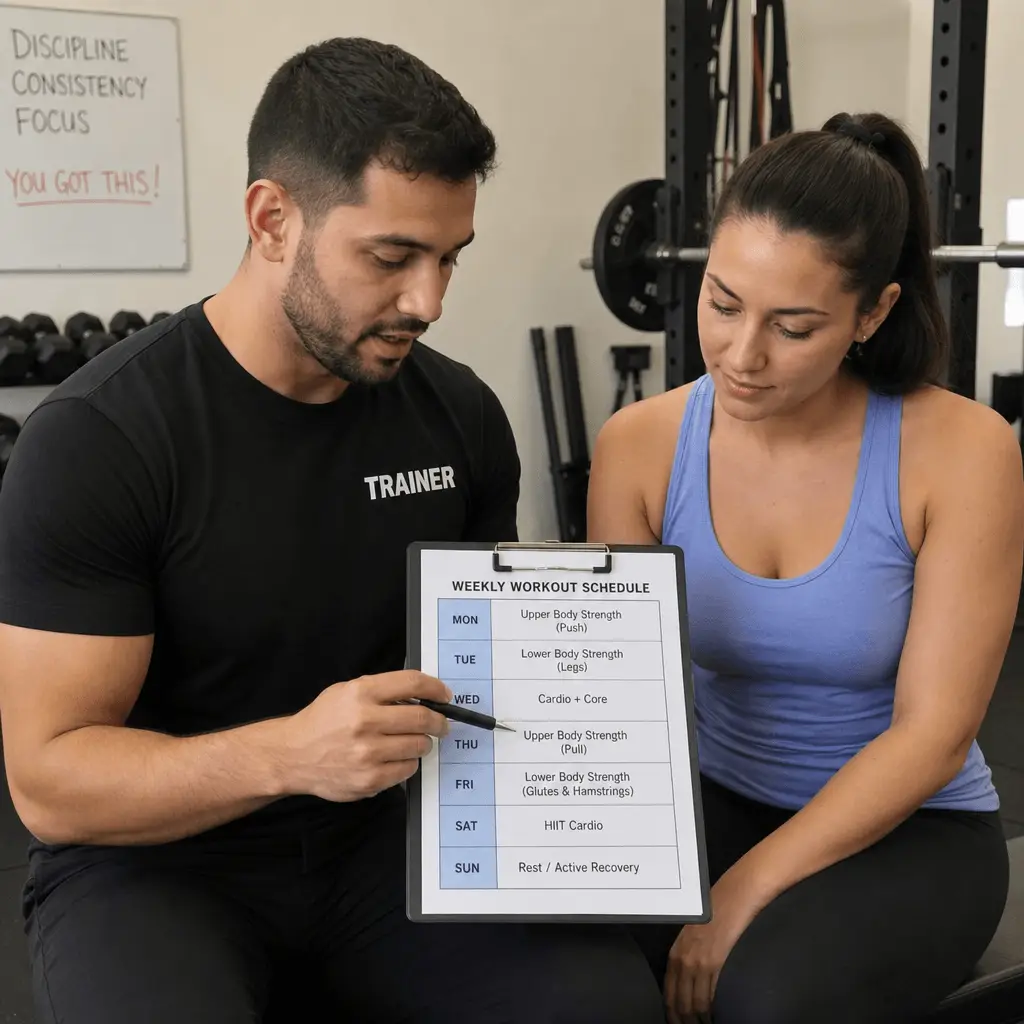
A balanced week usually includes strength training, cardiovascular work, mobility, and rest. Your trainer can organize those pieces so you are not guessing. The goal is to make exercise frequency sustainable rather than random.
Here is a practical example for a beginner seeing a trainer twice per week:
Monday: Personal training session focused on full-body strength and form.
Tuesday: Light cardio or walking to build consistency without heavy fatigue.
Wednesday: Rest or mobility depending on soreness and schedule.
Thursday: Personal training session with strength, core, and conditioning.
Friday: Easy walk or short home workout from your trainer’s plan.
Saturday: Optional cardio, recreation, or mobility based on energy.
Sunday: Rest and planning for meals, workouts, and sleep.
This structure works because it gives you repeated strength practice, enough movement to support health, and enough recovery to adapt. It also gives your trainer feedback: if you are too sore, not challenged, or skipping solo workouts, the plan can be adjusted.
Signs your schedule is working
Results are not always visible in the mirror right away. Early progress often shows up as better coordination, less intimidation, improved energy, and more confidence with exercises. Over time, you should see clearer performance changes.
Look for these signs:
You complete most planned workouts each week.
Your form feels more controlled and consistent.
You can lift slightly more weight or complete more quality reps.
You recover well enough to train again.
You understand what to do when your trainer is not there.
Your clothes, measurements, energy, or strength trends are moving in the right direction.
If none of these are happening after several weeks, your personal workout plan may need adjustment. The answer may be more sessions, but it could also be better sleep, improved nutrition, simpler workouts, or clearer goals.
When to increase or decrease sessions
Increase your trainer frequency when you are missing workouts, feeling lost, learning complex exercises, or preparing for a specific goal. More coaching can reduce guesswork and help you practice correctly. It can also provide accountability when motivation is low.
Decrease frequency when you can train independently with good form, understand your plan, and stay consistent without as much supervision. Many people move from three sessions to two, or from two sessions to one, once habits are established. That is not a step backward; it can be a sign that coaching is working.
FAQ
Is seeing a personal trainer once a week enough?
Yes, once a week can be enough if you follow your assigned workouts between sessions. It works best for people who are self-motivated, have some exercise experience, or need guidance more than supervision.
How long does it take to see results from a personal trainer?
Many people feel stronger, more confident, and more consistent within the first few weeks. Visible changes vary based on training frequency, nutrition, sleep, starting point, and how closely you follow the plan.
Is two personal training sessions a week worth it?
For many beginners, yes. Two weekly sessions provide frequent coaching without overwhelming the schedule, making it easier to learn proper form and build a repeatable routine.
Do I need a gym membership to work with a trainer?
Not always. Some programs can start with bodyweight movements, resistance bands, or online coaching, though a gym or coaching environment may provide more equipment and real-time feedback. Medford Personal Training notes that beginners can start at home, but expert eyes can help prevent mistakes.
What should I do on days I do not see my trainer?
Follow your personal workout plan. That may include walking, mobility, cardio, recovery work, or a solo strength session, depending on your goal and current fitness level.
Start with a schedule you can repeat
The best personal trainer frequency is the one that helps you train consistently, recover well, and keep progressing. If you are unsure, start with two sessions per week, then adjust after your trainer sees how you move, recover, and follow your plan. A smart schedule should make fitness feel more structured, not more confusing.
Ready to build your personal training schedule?
If you want help choosing the right number of training sessions and building a personal workout plan around your goals, visit Medford Personal Trainer today. Click here to get started.